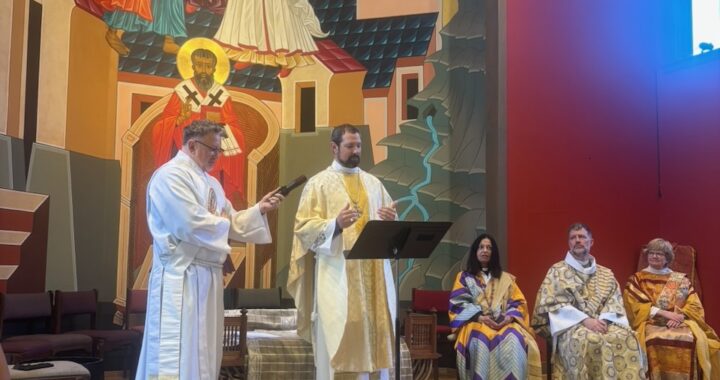
As the co-sponsoring bishop of Missio 2026, the annual global mission conference of the Episcopal Church, Bishop Austin Rios of the Diocese of California presided and preached at the Missio Eucharist at St. Gregory of Nyssa Episcopal Church in San Francisco on Wednesday, April 16. Following is the text of his sermon, entitled “Servant of the Gospel,” which was based on Ephesians 3:1-12:
We who have been baptized and made members of the mystical Body of Christ—through that mysterious and wonderful collaboration between God’s grace and human actions— are called to both incarnate the gospel and mature spiritually toward the supreme example of Jesus Christ.
Of this gospel I have become a servant according to the gift of God’s grace that was given me by the working of his power. Ephesians 3:7
Paul spends the majority of his letter to the Ephesians trying to convey the power of this calling and empasizing that the dividing wall and hostility that separates Jews and Gentiles—and, by extension, any other opposed groups — has been destroyed once and for all in Christ.
Though this new reality is ever operative for those in the church, and constitutes the basis of our ecclesial identity, mission and hope, it can often feel deflating to see how far we’ve fallen from its promise.
Especially as the lie of Christian Nationalism possesses this country, with its easy idolatry quick to coopt the symbols and superficialities of our faith without any of its sacrifice or responsibility, we who—like Paul—have become servants of the gospel, are accountable for modeling and proclaiming a different way.
No matter how the social media algorithm deals with that proclamation, and no matter how small our witness may seem.
In my half century of life, I can not recall a time when our shared Christian witness has been needed more than right now.
And yet, in order to witness well, we have to be about attending to spiritual practices that accumulate over time and draw us toward the maturity and connectedness in Christ we seek.
All of you gathered here for Missio 2026 are here because the words and calling of St. Paul are real and operative for you.
Through the contexts and the communities where you’ve served, the gospel has taken on more flesh, and my guess is that in both the most soaring and revelatory moments of your ministry and the most alienating and difficult death-filled valleys, you have known the accompanying grace and peace of God that passes all understanding.
A big part of maturing in our life in Christ is experiencing God’s presence in the wide fluctuations of our lives and finding stability not in our own strength or abilities but in the inexhaustible power of God expressed within and through faithful communities.
I’m here before you because I have learned over a lifetime of baptismal and 21 years of ordained ministry that God can do miracles when I put aside my fears and say yes to the spiritual stretching that allows each of us to walk the way of Christ.
When I look back, so many of the most important decisions requiring prolonged discernment in my life share a similar dynamic.
On the one hand there is a reasonable amount of fear that the gifts God has given me are not enough to meet the challenge ahead.
Even though the years have given me some ability to distinguish between legitimate fears for safety and the health of my soul from fears that are less rooted in reality, this mélange of trepidation is a large part of the discernment journey.
Having fears is part of being human, and it was important for me to surface those fears in prayer and confession—instead of just sublimating them—in order to honestly discern where God was calling me.
But ultimately—and I have grown to trust in this part of the discernment dynamic even more as I’ve aged—my fears give way to the assurance that I do not have to be anyone beyond who God created me to be in order for God’s way to become manifest through the ministry to which I’ve been called.
My willingness to be led by God, to trust that God can and will do things I can’t plan or imagine, and to stake my faith and life on the assurance that living this upside down gospel in a world enamored with hierarchy makes a difference—this saying YES to God is what casts out fear and makes transformative ministry possible.
I remember this dynamic being at play when wrestling with the call to ordination and it was there when I walked into Jane Butterfield’s office and contemplated a YASC placement in Mexico following seminary.
I experienced it again when discerning whether to serve as a priest in my second language, whether to accept the call to serve in the multi-lingual and multi-cultural context of ministry in Rome, and most certainly when considering my current call here in California.
At each juncture, my fears over my own inadequacies were real and threatening.
But each time I said yes to what I only partially could know beforehand—
Each time I stepped out in faith and found my footing through God’s unstoppable grace—
The Holy Spirit’s presence was palpable and God was able to accomplish things in the communities I served beyond my imagination and understanding.
I witnessed how empty the idol of mammon is compared to the richness of believers sharing community life.
I’ve seen broken bodies and hearts healed, outcasts made pillars of the church, and the subtle, but undeniable, miracle of followers of Christ finding freedom in the gospel and finally letting go of the world’s definitions and divisions.
I think this dynamic is what Paul both experiences and labors to relate in his letter to the Ephesians.
He went from zealous persecutor to apostolic proclaimer because of the graceful revelation on the Damascus Road and because Ananias laid aside his fears and trusted God enough to call the destructive Saul his brother.
Paul knew what it meant to live in a divided world where tribal affiliation determined all, and once the scales fell from his eyes, he gave his life to a gospel that claims Christ has reconciled all in the resurrection and put to death the hostilities that plague us through the cross forever.
The telos of our humanity is Teilhard de Chardin’s Omega Point of evolution— the new humanity that Christ enables and calls us to live in this world as we will in eternity.
Christ has both incarnated and opened the door to this new humanity, and we participate in being transformed toward the new humanity through Baptism and the journey of spiritual maturation that flows from it.
But, I suspect, the vast majority of people in this country and around the world do not equate Christianity with this calling.
Instead, the powers and the principalities have managed to convince others that our faith is really about superficialities and gaining wealth, political power, and egoic fame rather than the deeper transformation the gospel empowers.
We who, through baptism, have been entrusted with this gospel proclamation, are called to be bold as we witness together to the truth that truly sets us free and the peace which passes all understanding.
And yet no doubt the fears that accompany this discernment journey, from the churchwide to the personal levels, can feel especially intensified these days.
I can offer no panacea to assuage these fears, nor an assurance that they will subside anytime soon.
But what I do have I offer free of charge—that our God has always been in the business of working wonders through those who say yes to God’s way when fear and custom advocate another.
From creation’s genesis as dust became humanity through the infusion of God’s breath, to Moses’ uncertainties in facing Pharaoh, to the prophets’ calling, to Mary’s yes, to Paul and Ananias’ yes, even to our own yes to God’s will in fear and trembling —
The way of God is revealed and gains transformational power as flawed but faithful humans trust God enough to allow the holy to be born through them.
As we contemplate how to pursue God’s mission together as a church and as a people—across contexts that may feel overtly hostile or hedonistic— let us never forget the gift of our forebears in the faith.
May the faith that reached us through them be amplified through the witness of our own lives.
May the gifts God has given you for ministry shine brighter than your fears, and may you grow in your trust of God’s guidance arising in the heart as well as through the roots of the community where you serve.
And may we find our joy, purpose, and eternity in becoming servants of the gospel, and marvel at how the grace of God—working through us—will break down dividing walls, set prisoners and captives free, and ultimately usher in the new humanity that Christ makes possible.